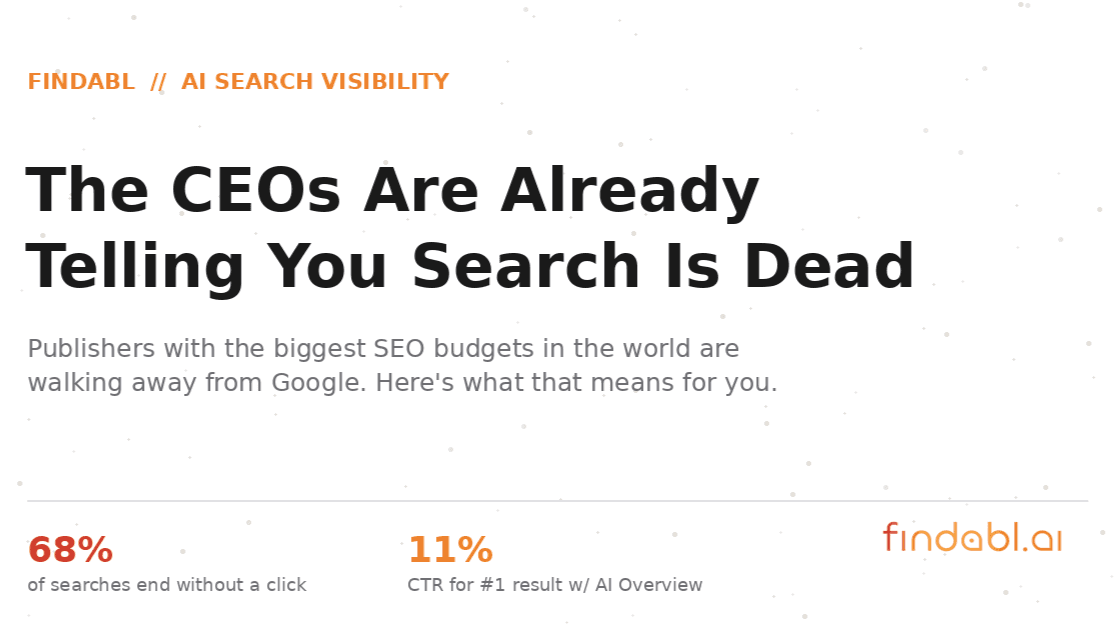
The CEOs Are Already Telling You Search Is Dead
If you're still building your marketing plan around ranking #1 on Google, you're planning for an internet that the biggest publishers in the world have already stopped counting on.
This isn't speculation from a martech vendor. It's coming from the people running some of the most search-dependent businesses on the planet.
Condé Nast's CEO recently told his own teams to build their business plans as if organic search traffic doesn't exist. Not "prepare for a decline." Assume it's zero.
USA Today's CEO said something similar on a podcast this year: their company is no longer counting on search traffic to be there in any meaningful way, and they're actively building revenue paths that don't depend on it.
People Inc., the publisher behind dozens of major consumer sites, has said blocking Google entirely is a real option on the table.
Sit with that for a second. These are organizations with dedicated SEO teams, seven-figure content budgets, and decades of experience gaming the old system better than almost anyone. And they're the ones walking away first.
Here's why.
Zero-click searches — where someone searches, gets their answer, and never visits a website — now account for roughly 68% of all Google searches. A decade ago that number was 45%.
Even ranking #1 doesn't mean what it used to. Before AI Overviews, the top search result got clicked about 27% of the time. Now, when an AI Overview sits above it, that click-through rate drops to around 11%.
The traffic isn't slowing down. It's evaporating:
What this means if you're not a media company
You don't have a newsroom or a traffic-dependent ad business. But you have the same underlying problem: your customers are increasingly getting their answers before they ever reach a website — yours or anyone else's.
The question isn't "how do I rank higher." It's "how do I show up as the answer" — in ChatGPT, in Gemini, in AI Overviews, in Perplexity — when someone asks the exact question your business solves.
That's a different game with different rules. It rewards structured, verifiable, well-organized information over keyword density and backlinks. It's winnable right now, while most of your competitors are still optimizing for a search engine that increasingly doesn't send anyone anywhere.
The publishers with the most to lose already changed their plans. Small and mid-sized businesses have the advantage of being able to move faster than they can.
The only question is whether you move now, while it's still early, or after everyone else already has.
Sources
Katie Baker, "The End of Google Search—and the Internet—as We Know It", The Ringer, Aug. 4, 2026
Condé Nast CEO Roger Lynch, interview on TBPN (May 2026)
USA Today CEO Mike Reed, interview on The Rebooting Show podcast
People Inc. CEO Neil Vogel, interview with The Wall Street Journal
Amanda Natividad (SparkToro), zero-click search data cited on NPR
Click-through rate data (#1 ranking with/without AI Overview), The Telegraph, May 2026
Cloudflare, 2026 report on bot vs. human web traffic share
Nicolas Bouliane, "AI Is Killing All About Berlin"
more posts
The Business AI Recommends Isn't Always the Best One. It's the Best Documented One.
AI recommends the business it can verify, not the best one. Here's why documentation beats quality in AI search - and how to fix your trust signals.
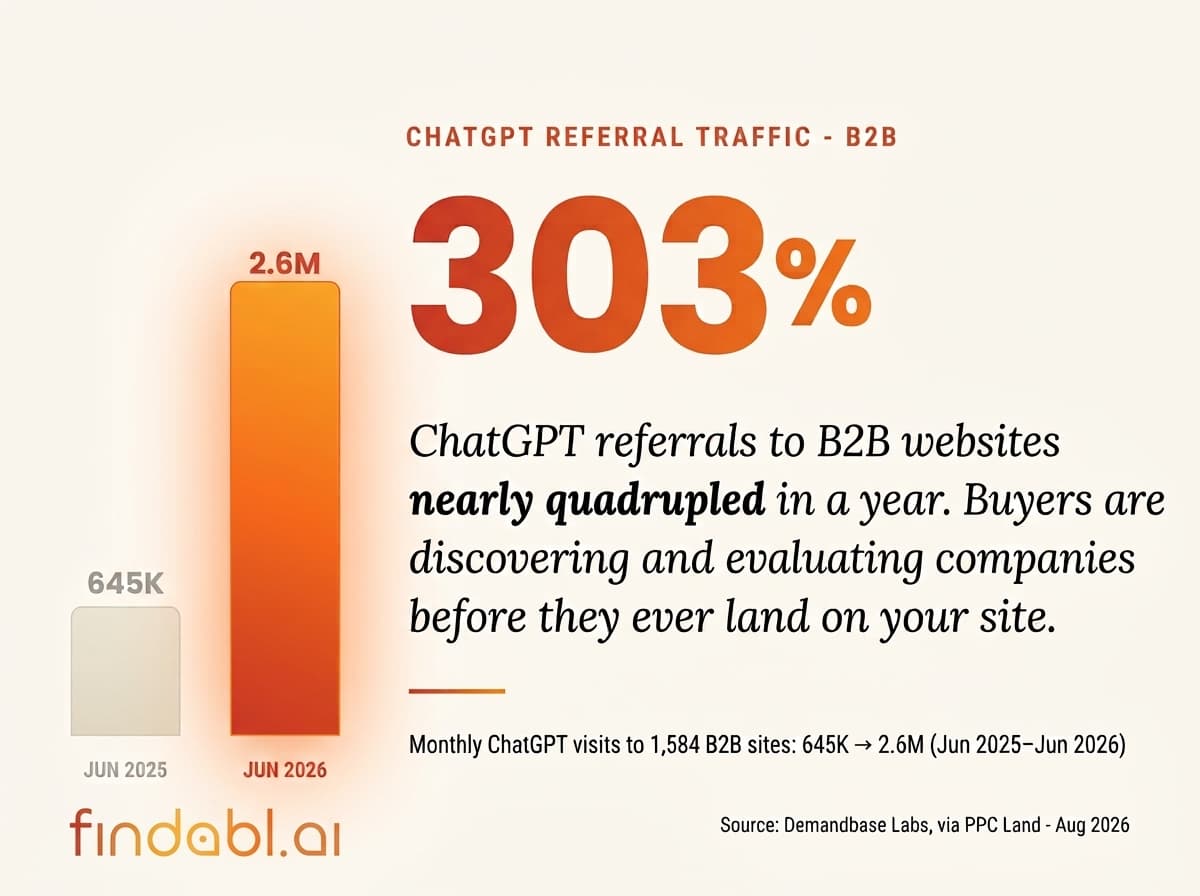
AI Referral Traffic to B2B Sites Is Up 303% — Is Your Brand Part of the Conversation?
AI Referral Traffic to B2B Sites Is Up 303% — Is Your Brand Part of the Conversation?

Your Website's Biggest Visitor Isn't Human Anymore
Your Website's Biggest Visitor Isn't Human Anymore