claim your business in chatgpt: what small businesses need to know
On November 10, 2026, OpenAI introduced a beta called Businesses in ChatGPT. For the first time, a business can step in and take control of the profile ChatGPT shows about it. For small businesses, this is one of the most practical AI findability updates in months.
Here is what launched, who can use it, and what to do next.
What is Businesses in ChatGPT?
OpenAI describes the beta as a new way for businesses to connect with the 1.2 billion people who use ChatGPT each week. Through a dashboard called Business Hub, a business can claim its profile, manage its information and see insights on how people engage with it on ChatGPT (OpenAI).
Once a claim is verified, a business can update key details and add a self-service product feed with pricing and availability. OpenAI also says eligible businesses can claim a profile without needing an ads account or a ChatGPT Enterprise agreement (FindSkill).
How to claim your business
The process is short. Sign in to ChatGPT, open Business Hub from the sidebar, search for your business by name, select the matching listing and confirm the ChatGPT account that will manage it (Flavio Copes).
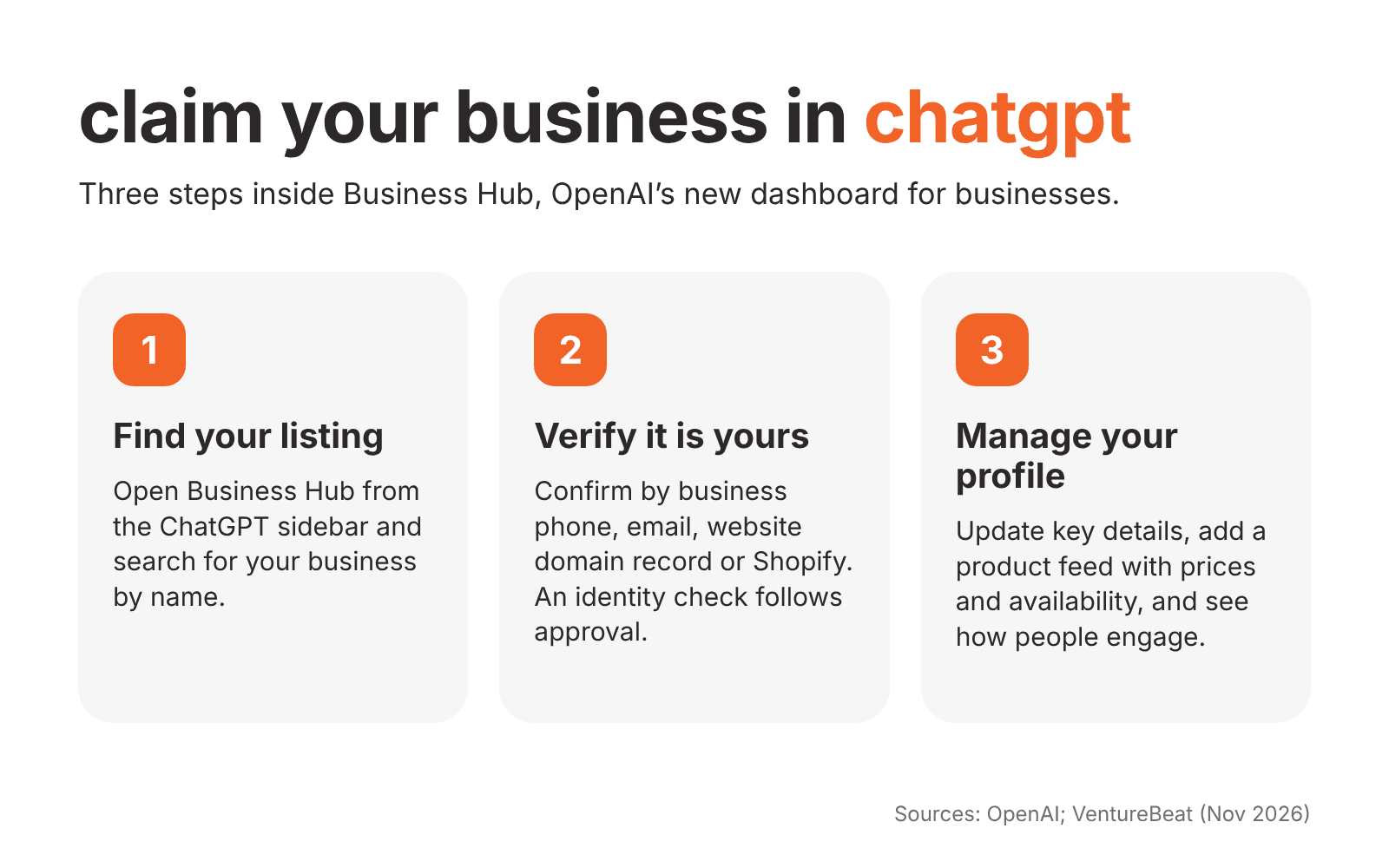
Next comes verification. Depending on the business, OpenAI can verify a claim through a business phone number, email address, website domain or Shopify account. After approval, the person managing the listing completes a separate identity check through Persona before they can publish profile changes, connect a product feed, see analytics or create an agent (VentureBeat).
Businesses with several locations should plan ahead. Each location is claimed separately, and OpenAI has not documented a bulk tool or API for claiming profiles (Birdeye).
Who can claim what, for now
Eligibility depends on the type of business. Online businesses with a website can claim a profile wherever ChatGPT is available. Local stores and restaurants can currently claim only a listing that already exists in the United States, while eligible online businesses may be able to add a new one (Flavio Copes; Birdeye).
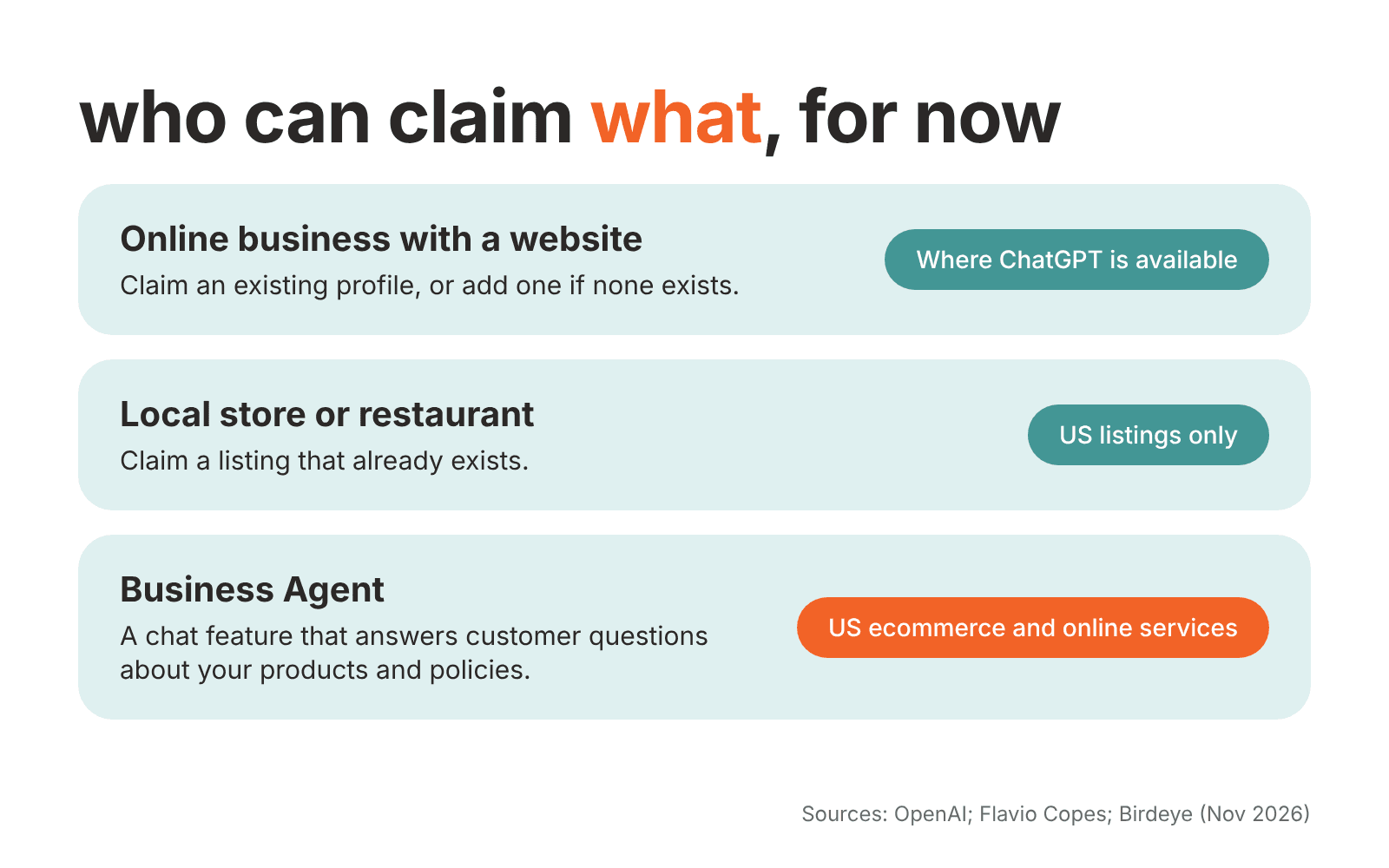
Business Agents are a separate feature. These are chat assistants that answer customer questions about a business's own products and policies, and they start with eligible ecommerce and online service businesses in the U.S. (OpenAI).
What businesses can see
The dashboard is built to show how often ChatGPT mentions a business and sends people to its website. OpenAI has also said it does not share users' conversations or Business Agent chats with businesses (VentureBeat).
One point worth knowing: an analysis of OpenAI's terms notes that OpenAI can create and show a listing for a business whether or not it claims it (Gaurav Tiwari). Claiming gives a business a say in what that listing contains.
What to do this week
Check how ChatGPT describes you today. Ask it about your business and your services, and note anything that is out of date.
Gather your verification details. Have your business phone, email or website domain access ready.
Claim your profile through OpenAI's own Business Hub. Use OpenAI's pages, not a third-party link.
Keep your details consistent everywhere. Your name, services, hours and locations should match across your website and profiles.
ChatGPT is one platform, and customers use several
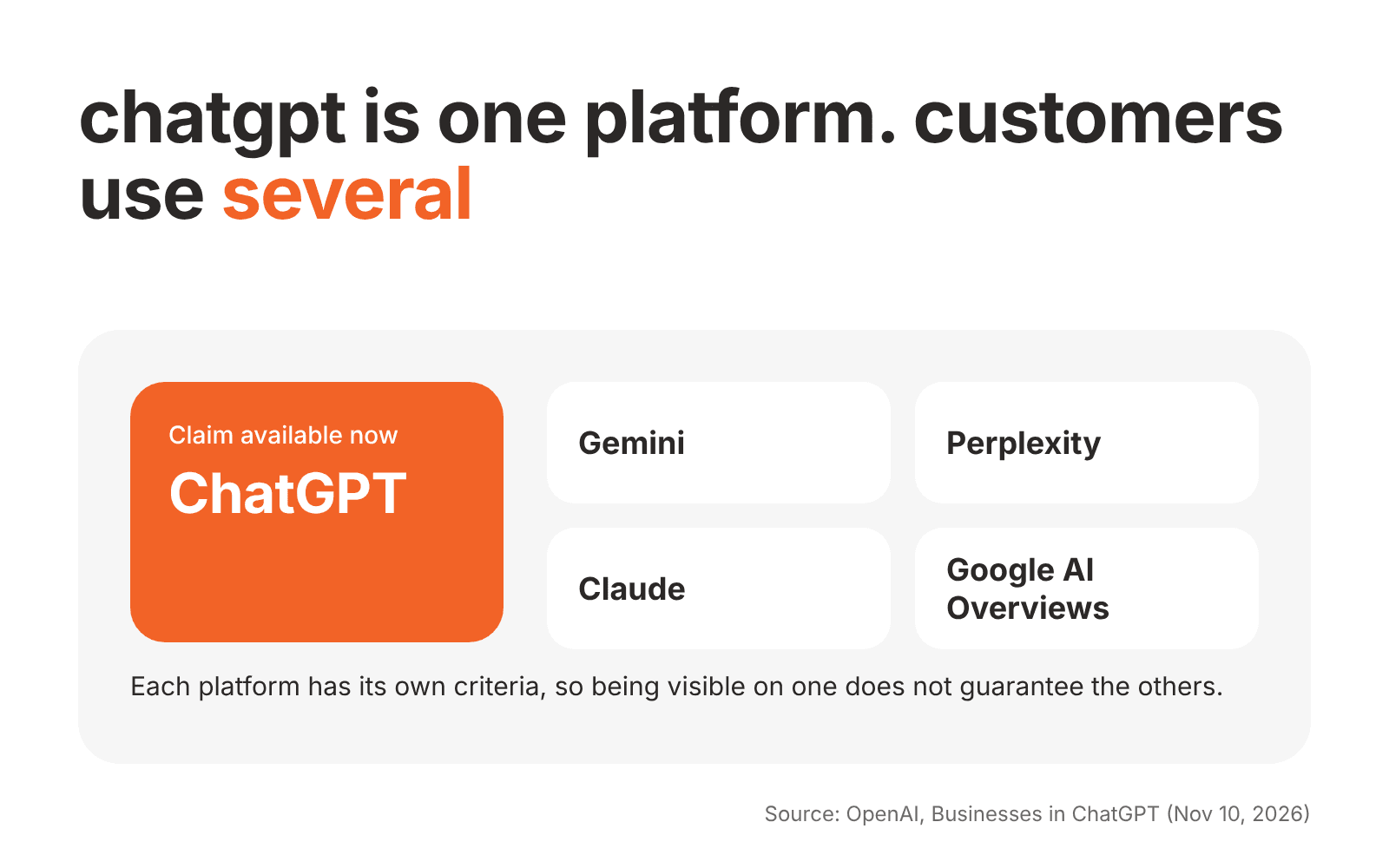
Claiming a profile is a strong first step, but it covers one platform. People also ask Gemini, Perplexity, Claude and Google AI Overviews for recommendations, and each platform has its own criteria. Being visible on one does not guarantee being visible on the others.
That is why AI findability services look at the whole picture: how clearly a business is described, how consistent its information is, and how easily AI tools can understand and recommend it across platforms.
The bottom line
Businesses in ChatGPT is still in beta, and the rules will keep evolving. The businesses that benefit most will be the ones that act early, keep their information accurate and think beyond a single AI tool. Search is changing, and a business that is easy for AI to find and recommend has a real advantage.
Want to know how visible your business is across AI search? Visit findabl.ai.
get found.
Sources
OpenAI, Introducing Businesses in ChatGPT (November 2026)
VentureBeat, OpenAI lets you claim your business in ChatGPT and set up a custom agentic AI customer sales rep (November 2026)
Flavio Copes, A deep dive into Businesses in ChatGPT (November 2026)
Birdeye, How to claim your business in ChatGPT: A step-by-step guide (November 2026)
FindSkill, Claim Your Business in ChatGPT: Business Hub Setup (2026) (November 2026)
Gaurav Tiwari, How to Claim Your Business in ChatGPT (November 2026)
About Findabl
Findabl (findabl.ai) is an AI visibility and Answer Engine Optimization (AEO) agency that helps small businesses show up when people ask ChatGPT, Gemini, Claude, Perplexity and Google AI Overviews for recommendations. Its AI findability services combine AI-powered tools with real human strategy, structuring a business's online presence so AI understands and recommends it, with simple plans, quick setup and monthly visibility snapshots. Findabl serves clients globally, with its main office in Toronto and a second office in Fort Lauderdale, Florida. get found.
more posts
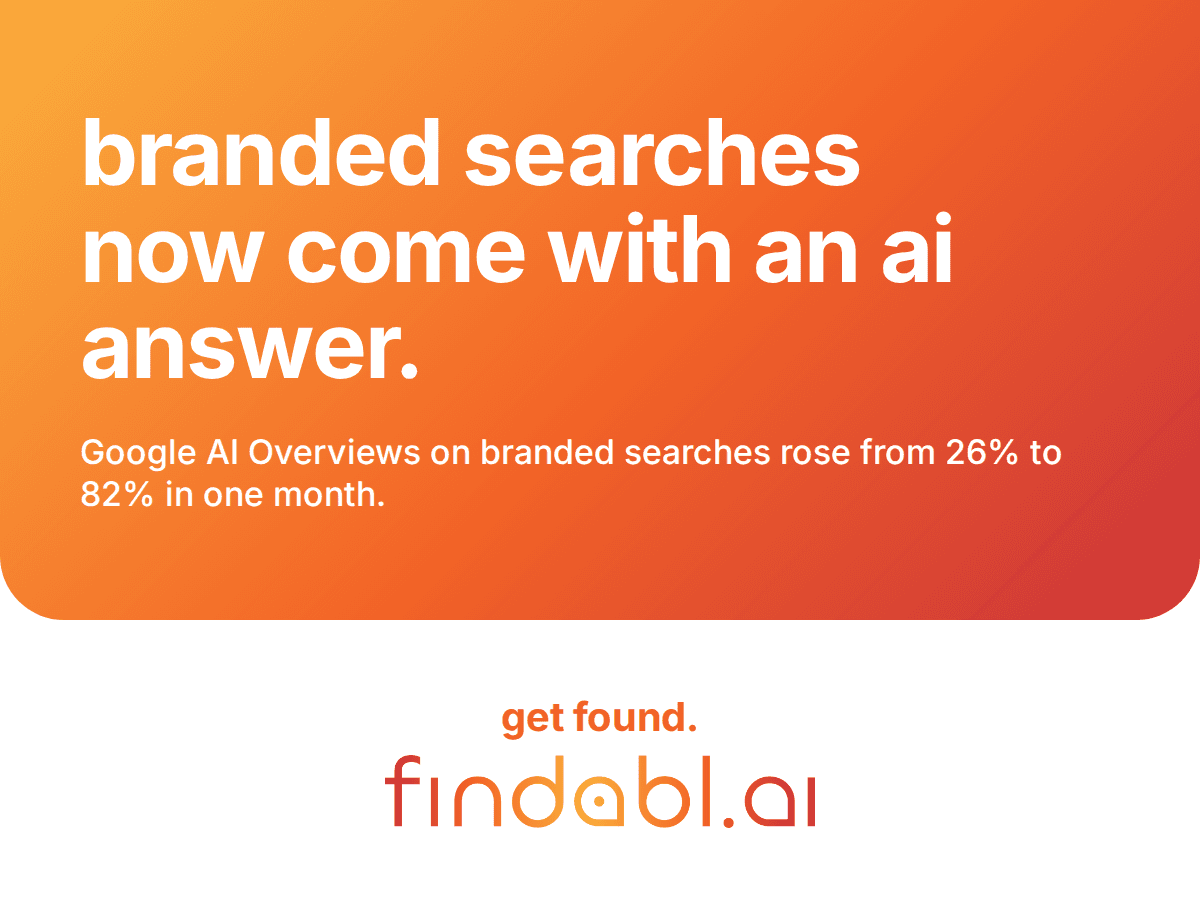
branded searches now come with an ai answer.
When someone searches for a business by name, most owners assume that is the safe corner of search. New data suggests the results page those customers land on is changing, and quickly.
getting found in the age of ai: findabl's co-founders on the Beyond MD podcast
getting found in the age of ai: findabl's co-founders on the Beyond MD podcast
ask ai twice. get two answers.
Why one AI answer never tells the full story